Hi folks. It’s been a while – which doesn’t mean things have been quiet in the world of higher education in Central Asia. Far from it, in fact. My news feed has been full of stories, whether it’s announcing yet more international partnerships, the occasional closure of a university, or the ongoing politicization of students’ lives.
Earlier this month, I had a chance to reflect on some of these developments for the Canadian University Vice Presidents Network (UVPN), convened by my friends at Toronto-based Higher Education Strategy Associates (quick plug for CEO Alex Usher’s very popular blog, One Thought to Start Your Day).
From a Canadian perspective, Central Asian higher education – and indeed Central Asia itself – is something of an unknown. Having worked at three different universities in Canada and immersed myself in the study of higher education in this setting over the past decade, this aligns to my overall observation is that Canadian higher education is in some respects much less internationally oriented than other systems around the world.
Of course, there are numerous international research collaborations, a handful of student exchange programs, and Canada hosts a huge number of international students (although significantly fewer since 2024; see my research on this here and here). But when it comes to the cross-border movement of higher education, particularly in the realm of what is called provider mobility in transnational education, Canada is nowhere to be seen.
This isn’t necessarily a bad thing. Provider mobility, which encompasses branch campuses, joint universities and the like, is coming under increasing scrutiny for reproducing inequalities and has been called a form of neo-colonialism. Canada has plenty of that to deal with at home before looking outside of its borders.
But Canada’s absence is surprising for a country that otherwise punches above its weight in higher education (and my unconscious choice of metaphor is perhaps also very telling). So, given this context, where does one start when invited to talk to Canadian university leaders about international collaboration, regional geopolitics, and the future prospects for internationalization?
A few months ago, I was asked to give two similar talks for Central Asian university leaders, and there was a nice symmetry to being able to invite both sets of leaders to think through the same issues. For the Canadian audience, I stepped back a little to set the scene.
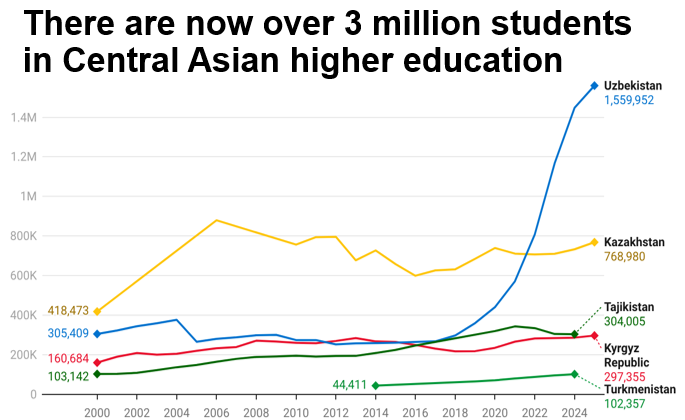
This helps, for example, to understand what’s going on in Uzbekistan that has produced the exponential growth in enrolments in the last five years.
may be reproduced with appropriate credit (CC BY 4.0)
Did you know, for example, that the number of students in higher education doubled between 2023 and 2025 alone? (If you’re a long-term reader of this blog, you probably did, but still, it’s an incredible shift that bears repeating.) This means, as the graph shows, that there are now over three million students in higher education across the five Central Asian countries.
For the UVPN group, I also talked about different types of institutional partnerships that we see in Central Asia based on some new research I’ve conducted with my graduate students Gui Li and Emine Sheykhametova (publication should be out in 2027). Across these partnership models, there were plenty of examples to draw on… but Canada is not represented among any of them.
Again, this may not be such a bad thing, especially if, as insiders told me in Kazakhstan, a good number of the recently opened branch campuses may end up folding in the next few years due to unsustainable growth. On the other hand, with growing calls from within the region to shape higher education systems around local needs and a growing desire to build out/up from within, Canadian universities that are serious about forging long-term, mutually beneficial relationships with their Central Asian counterparts may very well be welcomed in.


Leave a Reply