I’m just back from Kazakhstan, where I was invited to speak at the Eurasian Higher Education Leaders’ Forum (EHELF) at Nazarbayev University in Astana and the International Association of University Presidents Central Asia Regional Conference, organized by Almaty Management University in Almaty. Let me take the opportunity to thank the organizers of these thought-provoking events and in particular Dr Dilrabo Jonbekova and Dr Sholpan Tazabek.
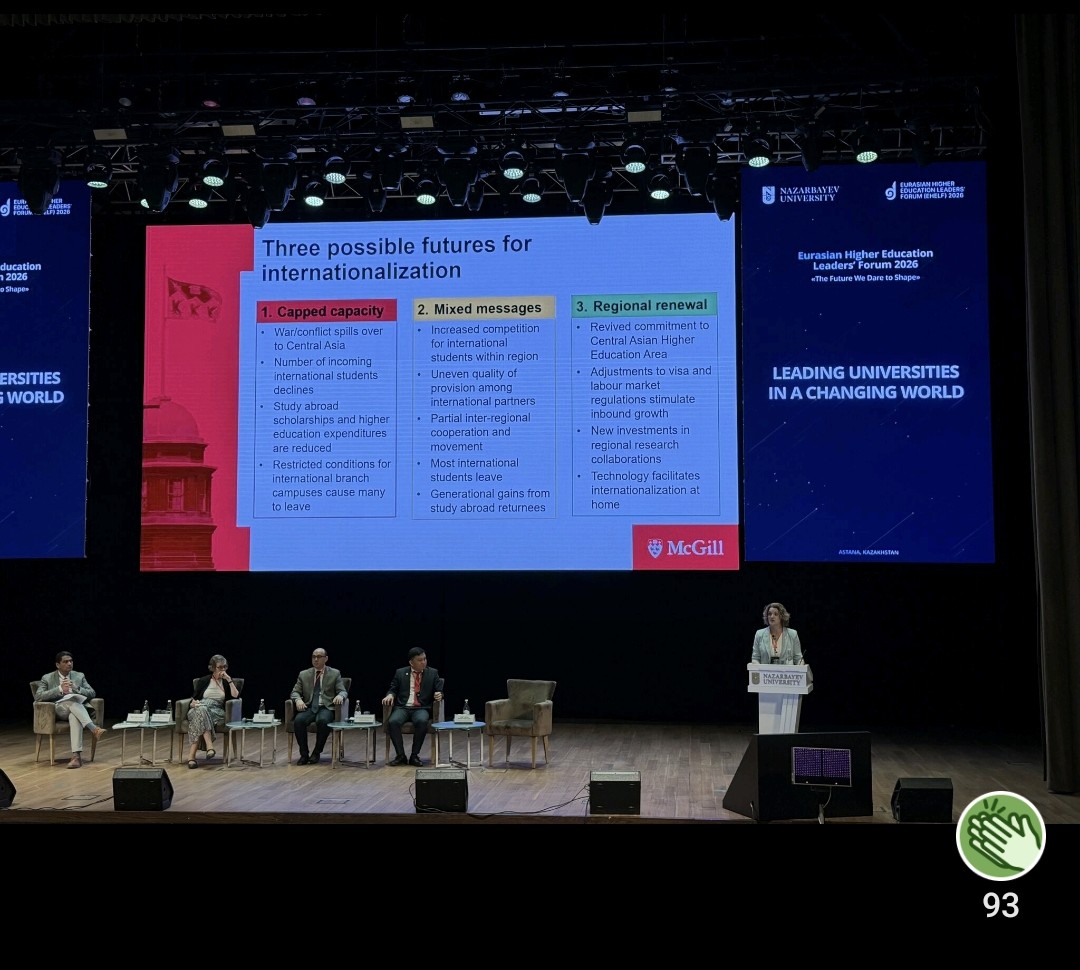
In my talks, I focussed on two of my favourite topics – the internationalization of higher education in Central Asia and what the future(s) might look like in the region.
Did you know that Central Asia has the highest outbound mobility rate in the world? Fully 15% of the region’s 3 million students go abroad to study, with Russia remaining the top destination despite its increasing isolation.
And have I mentioned Uzbekistan? Not only has its higher education system grown exponentially in recent years, its student population DOUBLED between 2023 and 2025 to over 1.5 million, and Uzbekistan is now the third highest sending country of international students. Quick plug: I have a book chapter coming out later this year on recent developments in higher education in Uzbekistan, so look out for that.
You might ask why studying abroad remains so popular, especially when modes of internationalization in the region are diversifying. There are lots of reasons, but here are some that I think are the most relevant:
- National higher education systems cannot keep pace with rising demand – this is especially relevant for Uzbekistan
- Concerns persist about domestic programme quality, even when governments in the region have made great strides to enhance higher education at home
- There’s a growing middle class with greater capacity to finance overseas study
- The prospects of employment opportunities, whether abroad after studying or back home with the potential prestige that an overseas degree adds
- Supportive government policies such as the scholarship schemes that four of the five Central Asian countries offer
In my talks, I laid out some key tensions that could threaten internationalization, but which might also bring opportunities. Take geopolitical challenges as an example. Russia and Iran are very real threats due to their proximity to the Central Asian neighbourhood, although as noted above, Russia remains the top host country for Central Asian students. Beyond wars and conflicts, there’s also the ripple effect of growing insularity in the domestic policy of other countries, mainly in the ‘West’ (such as Canada, which is currently in the middle of shooting itself through the foot by limiting international student enrolments). This might present opportunities for governments that are prepared to be more open.
I’ll talk more about what might lie ahead in my next post.
In between conferences, I had the chance to catch up with friends, get to know colleagues working at universities across Kazakhstan, plan new research projects, teach two online classes to my McGill students in the middle of the night, work from the National Academic Library surrounded by students preparing for their exams, and even found time to try out Astana’s sparkling new light rail transit (loved it, would recommend). An excellent trip all round.


Leave a comment