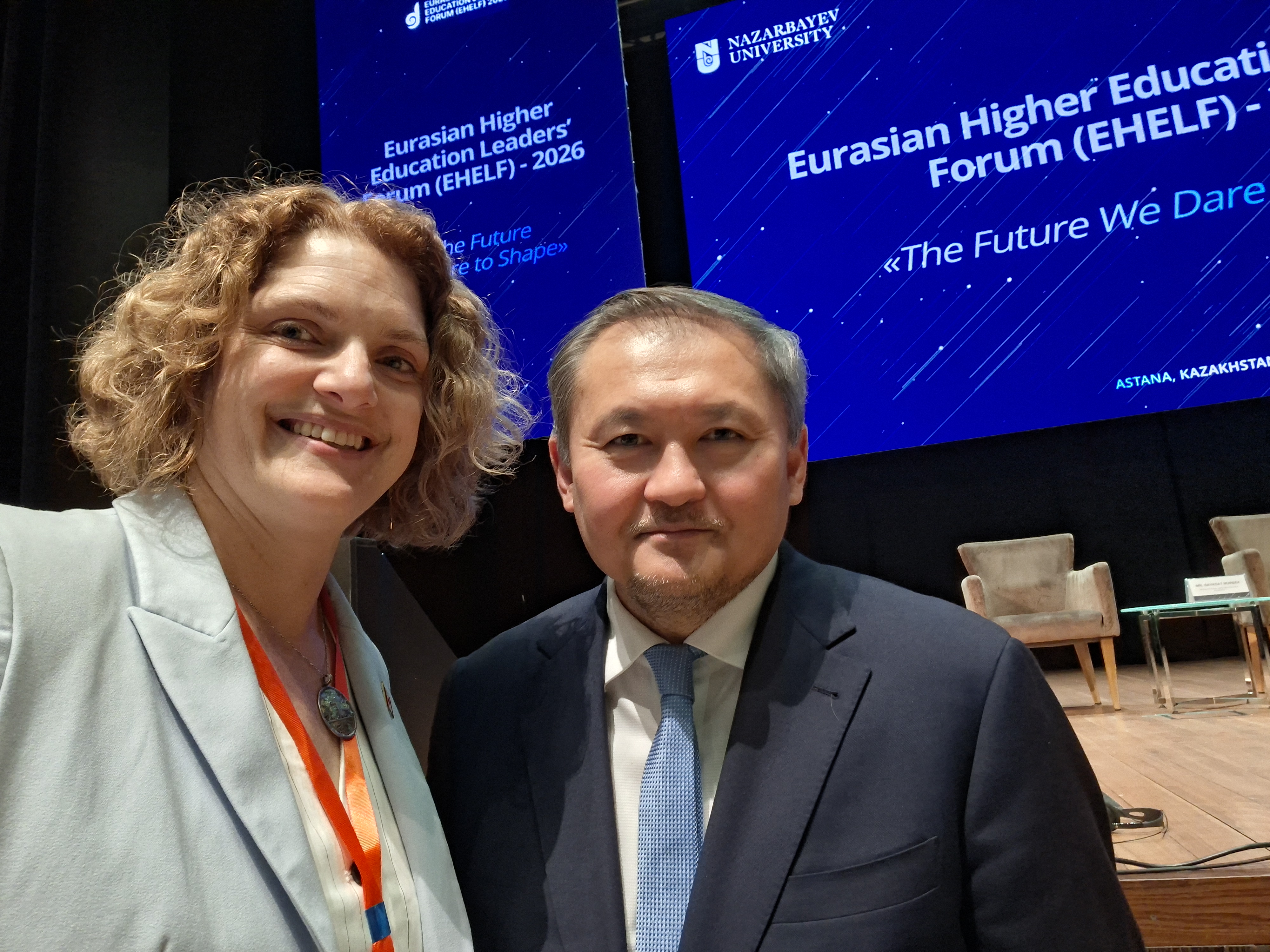
At the recent Eurasian Higher Education Leaders’ Forum (EHELF) at Nazarbayev University in Astana, I got to hear from Sayasat Nurbek, Minister of Higher Education and Science of Kazakhstan. That Nurbek is one of the longest serving higher education Ministers, having been in post for a venerable four years, speaks to his dynamism and rapidly evolving agenda. Whether everything he’s putting into place sticks for the long-term is something that my Kazakh colleagues questioned, but there does seem to be an overall admiration for his vision – or maybe simply his determination.
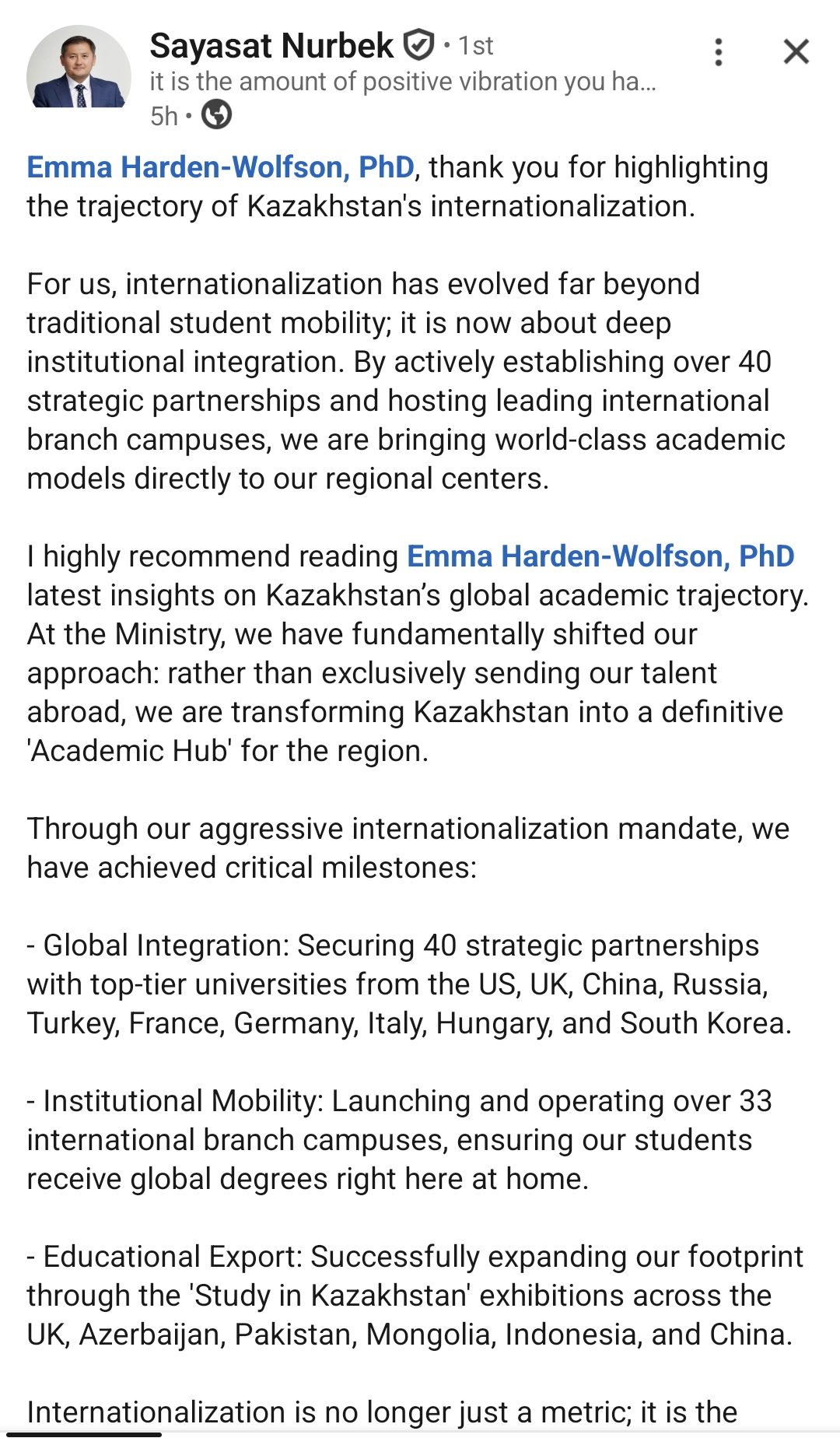
In his talk, he covered a lot – and I mean a lot – quoting Plato and Star Wars, using karate analogies, joking about his use of ChatGPT, and sharing how he’s been criticized for his actions, all the while somehow staying on message. As ministers go, he’s very accessible (just have a look at his social media).
Here are my four highlights from his talk.
First, freshly back from Brussels, Nurbek shared updated on talks about Kazakhstan becoming an Associate Member of Horizon Europe, a massive research funding program. If successful, Kazakhstan would be the first ex-Soviet country to join. More importantly, this would open access to collaboration and financing on research with partners in Europe and beyond (Canada recently became an Associate Member, for example) and support the government’s aspiration to transform local universities into research intensive sites.
Second, there are plenty of changes on the horizon for higher education financing. A new student loan scheme has been piloted and will roll out in 2027, with 0% interest on loans as part of a mission to keep access to higher education as high as possible. Student grants are expected to more than triple in amount by 2032. A new law aims to incentivize private companies to donate to endowment funds for higher education. And so on.
Third, AI, AI, and more AI. It’s safe to say that the Minister is a fan. He announced a new National AI Research University to be launched later this year (fittingly enough, in the futuristic dome shaped Expo 2017 building in Astana), a partnership with OpenAI, the fact that Kazakhstan is the first country in the world to mandate learning about AI in higher (and soon, secondary) education, heavy investment in supercomputers, AI-zation of routine administration and teaching tasks, and more.
Fourth, the number of international students coming to Kazakhstan has hit a record high (around 35,000) and there are ambitious plans to triple this. The Minister says demand is hugely outstripping supply and the lack of English medium programs is a major reason for this. In tandem, there is now a Study in Kazakhstan campaign to attract international students and amendments being made to immigration legislation to create a super visa with faster processing times, allowing years of study to count towards residency, and enabling international students to work.
Plenty to chew on here, with lots of exciting developments. And of course this raises a number of issues too: among others, a tendency to see higher education through a business model lens, a possible over-reliance on as-yet-not-fully reliable genAI, societal tensions if there’s a big jump in the number of international students. It’s currently full steam ahead in Kazakhstan.


Leave a comment