In my last post, I shared some thoughts on what’s currently happening in the world of higher education internationalization in Central Asia based on two talks I gave recently in Kazakhstan. As part of this, I embarked on some scenario planning to think through what desirable futures might look like, what challenges might lie along the way, and what opportunities there could be for the region.
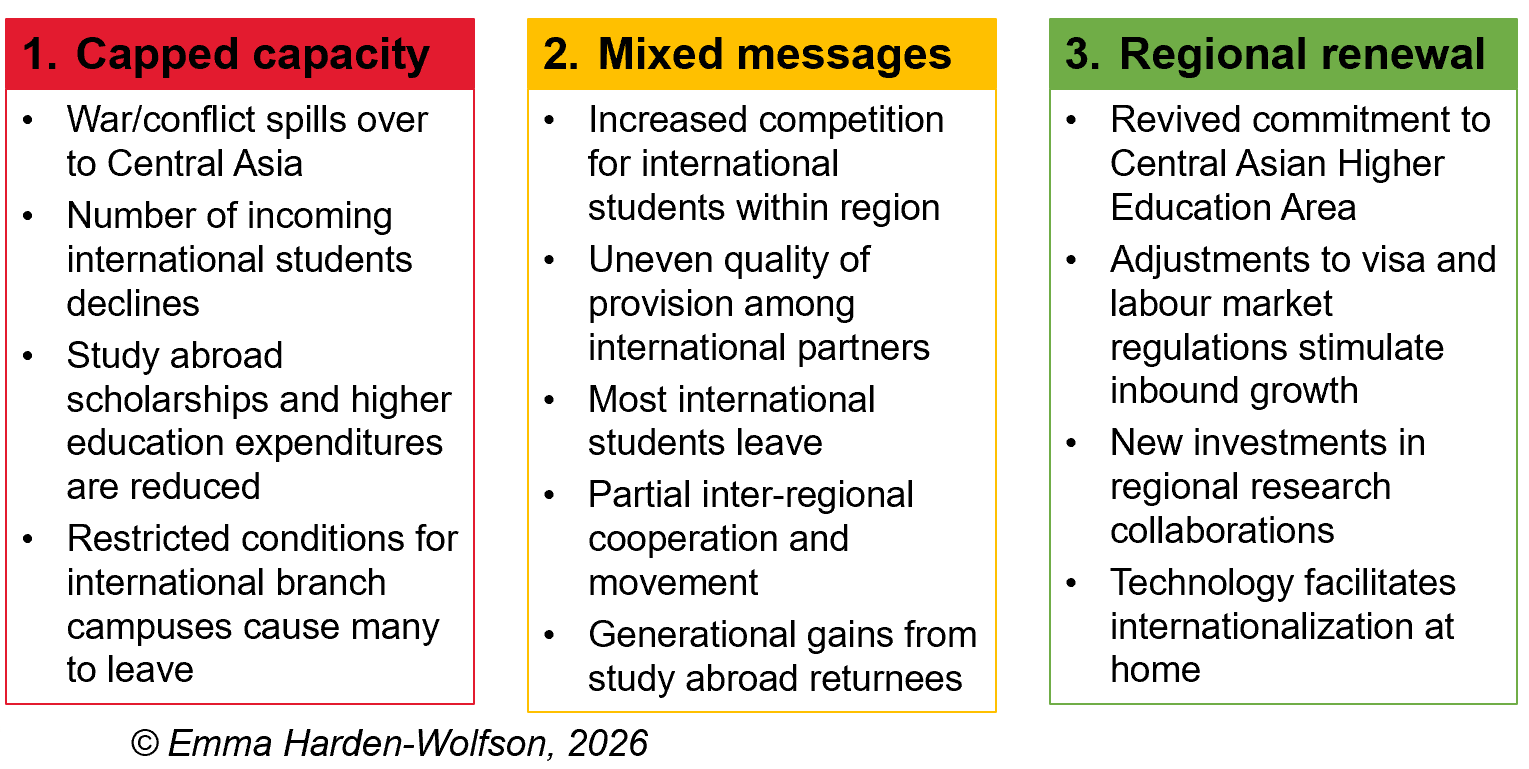
I came up with three possible futures, which to simplify are worst case (I call this scenario ‘Capped capacity’), a mix of bad and good (‘Mixed messages’), and best/better case (‘Regional renewal’) scenarios. These models are still developmental and focus on selected aspects of internationalization, but based on audience feedback, the points resonated and made sense.
In the capped capacity scenario, external geopolitics and restrictive domestic politics intertwine, bringing war or conflict to the region and reductions in the number of international students coming to Central Asia. Expenditure on higher education – already lower than in most other world regions at less than 0.4% of GDP – reduces further or is redirected to other areas and opportunities for students to study abroad with funding decline. Hampering conditions for international branch campuses or universities cause many to leave.
The mixed messages scenario imagines partial inter-regional cooperation and mobility, building on the 2025 agreement on the mutual recognition of degrees. There are also generational gains from study abroad returnees, which are already being felt in Kazakhstan with many Bolashak scholarship graduates now occupying high level positions in the public sector. On the other hand, as the countries seek to expand internationalization by attracting more international students, there is increased competition and most international students leave once their courses finish. The number of international universities operating in the region grows, but the quality of provision is uneven.
Moving to the regional renewal scenario, I imagined a revived commitment to creating a Central Asian Higher Education Area, first announced in 2021 with limited visible progress since then. This is bolstered by new investments in regional research collaborations. Governments would make adjustments to visa and labour market regulations to enable international students to make societal contributions beyond their period of study and stimulate economic growth (Kazakhstan is already in the process of making some changes to their immigration regulations, which I’ll talk about in my next post). And in this scenario, technology is harnessed for good to facilitate internationalization at home and expand access to international opportunities.
I’m planning to develop these scenarios further and also think through what the pathways from today to regional renewal might look like. Do let me know if you have feedback or ideas for these or other scenarios.


Leave a comment