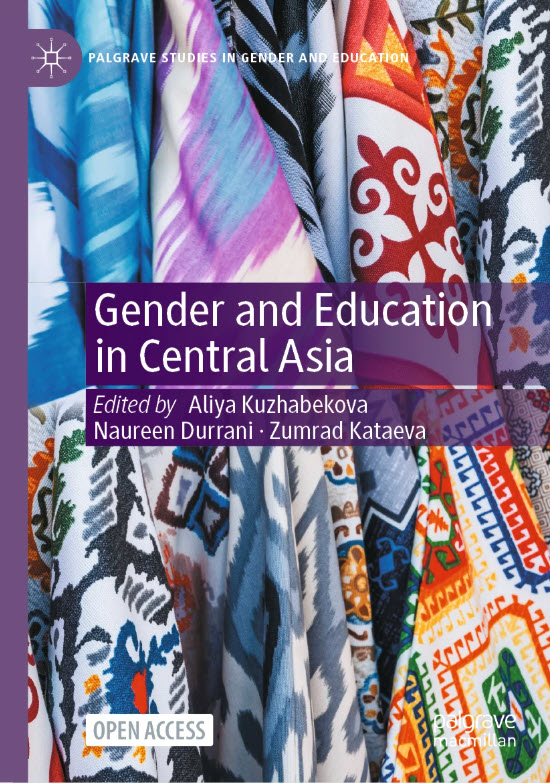
New publication alert!
I’m delighted to have a co-authored chapter out in the new title, Gender and Education in Central Asia, ably edited by Aliya Kuzhabekova, Naureen Durrani and Zumrad Kataeva. There’s much to celebrate here, including the fact that this is the first book to be published (in any language) on gender and education in Central Asia.
Gender has been de/re/constructed in Central Asia in multiple ways in recent years, despite widespread commitments to gender equality. Learn more about the barriers and challenges, progress and opportunities in this valuable edited collection.
The very deliberate efforts of the editors to showcase research by emerging scholars, primarily from Central Asia, and established authors, adds weight and importance to the book. It is a principle that should be taken up by other book editors.
I am very pleased to have a co-authored chapter in this collection. With Lyazzat Shakirova, we investigated all the available data we could find to study current and emerging issues in gender equality in education. You can find our contribution in chapter 3.
Oh and I’m totally obsessed with the beautiful cover image/design!
Here’s the official abstract for our chapter (and another post on this coming soon):
This chapter identifies current and emerging issues related to gender equality in education, providing a comparative analysis of education-related gender equality indicators across Kazakhstan, Kyrgyzstan, Tajikistan, and Uzbekistan. Using data from UNESCO, the World Bank Gender Data Portal, the United Nations Development Programme’s Gender Inequality Index, country-level data, and other sources, the chapter is organized into four sections. First, the gendered educational landscape is examined, encompassing educational participation and attainment in compulsory and post-compulsory education across the countries. Second, the chapter explores gender differences in fields of study in higher education to understand patterns of gendered behaviour in education. Third, the chapter examines the role of female educators—teachers and researchers, and fourth, the chapter explores whether educational achievements for women are translating into societal leadership gains. The chapter concludes with brief country summaries highlighting key issues for gender equality in education. Despite presenting some statistics for the first time, caution is warranted due to the subjective nature of data and its limitations in capturing root causes and structural effects of gender inequality.
Access the whole book here: https://link.springer.com/chapter/10.1007/978-3-031-75301-5_3

 Emma Harden-Wolfson
Leave a reply to Data on female university leaders – new University World News article – Emma Harden-Wolfson Cancel reply