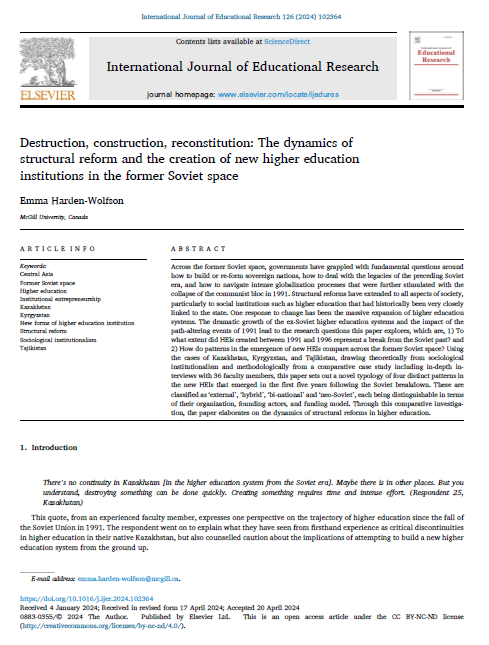
Hot off the press and available open access is my latest journal article, titled Destruction, construction, reconstitution: The dynamics of structural reform and the creation of new higher education institutions in the former Soviet space.
The article examines reforms in higher education in the aftermath of the Soviet collapse, focusing on the creation of new higher education institutions (HEIs) in Kazakhstan, Kyrgyzstan, and Tajikistan in the period 1991-1996.
The paper has its roots in my PhD thesis, which takes up broader questions about higher education’s responses to major institutional change (i.e. the fall of the Soviet Union) in Central Asia. I previously published another open access article, Surviving a crisis: Transformation, adaptation, and resistance in higher education, which outlines the main argument of the thesis.
The paper out today hones in on two aspects. First, the extent to which HEIs created in this formative period represented a break from the Soviet past (spoiler alert: they do… but they also don’t). Second, how patterns in the emergence of new HEIs compare across Kazakhstan, Kyrgyzstan, and Tajikistan.
The abstract for the article and reference are below; you can freely download it (and share it! Please share it!) from https://www.sciencedirect.com/science/article/pii/S088303552400051X.
Do you need further persuasion? OK! Here are three reasons why you should read the paper:
- The higher education systems in Kazakhstan, Kyrgyzstan, and Tajikistan collectively grew by over 200% in the first decade of independence. New HEIs were a huge part of that expansion, so it’s critical to understand how they reshaped the higher education landscape.
- I created a four-part typology to categorize and explain the new HEIs that emerged between 1991-1996 and would be curious to know what you think about this.
- It has some fantastic ‘origin stories’ of a handful of the new HEIs that were created, told to me by people who were there at the time and were generous enough to share their first-hand knowledge. For me, these stories are the best part 🙂
Abstract
Across the former Soviet space, governments have grappled with fundamental questions around how to build or re-form sovereign nations, how to deal with the legacies of the preceding Soviet era, and how to navigate intense globalization processes that were further stimulated with the collapse of the communist bloc in 1991. Structural reforms have extended to all aspects of society, particularly to social institutions such as higher education that had historically been very closely linked to the state. One response to change has been the massive expansion of higher education systems. The dramatic growth of the ex-Soviet higher education systems and the impact of the path-altering events of 1991 lead to the research questions this paper explores, which are, 1) To what extent did HEIs created between 1991 and 1996 represent a break from the Soviet past? and 2) How do patterns in the emergence of new HEIs compare across the former Soviet space, using the cases of Kazakhstan, Kyrgyzstan, and Tajikistan? Drawing theoretically from sociological institutionalism and methodologically from a comparative case study including in-depth interviews with 36 faculty members, this paper sets out a novel typology of four distinct patterns in the new HEIs that emerged in the first five years following the Soviet breakdown. These are classified as ‘external’, ‘hybrid’, ‘bi-national’ and ‘Soviet’, each being distinguishable in terms of their organization, founding actors, and funding model. Through this comparative investigation, the paper elaborates on the dynamics of structural reforms in higher education.
Reference
Harden-Wolfson, E. (2024). Destruction, construction, reconstitution: The dynamics of structural reform and the creation of new higher education institutions in the former Soviet space. International Journal of Educational Research, 126, 102364. https://doi.org/10.1016/j.ijer.2024.102364
 Emma Harden-Wolfson
Leave a comment